
Why 2026 Will Be the Year of Data Storytelling
Data professionals who can translate complex analysis into clear, compelling stories will stand out.
- | 5 min read
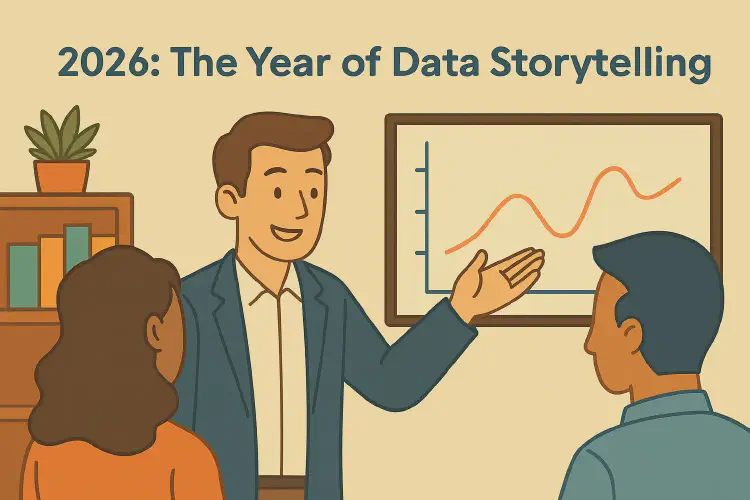
Over the past decade, companies have expanded their analytical capabilities with impressive speed, building data pipelines, adopting modern platforms, and embracing automation across every operational layer. Yet even with these advancements, many organizations continue to face a persistent obstacle: insights are generated at scale, but decisions do not accelerate at the same pace. The gap isn’t in the data; it lies in interpretation, and this is where data storytelling enters the picture, not in a dramatic narrative sense, but as a disciplined method for guiding stakeholders through insights, context, and implications.
In 2026, data storytelling will shift from a “nice addition” to a core skill that separates analysts who deliver value from those who simply produce dashboards. Organizations no longer need more reports or visualizations; they need professionals who can articulate meaning, frame relevance, and translate analytical findings into strategic clarity. As the field matures, the analysts who will be noticed are the ones who excel at this valuable yet still rare capability. Let’s explore this deeper.
The Shift Driving This Change
Three forces are merging to make storytelling the defining analytics skill of 2026.
1. Automation is absorbing routine analytical tasks.
As tools become increasingly automated, the work that once differentiated analysts is becoming faster and more accessible. This doesn’t eliminate the need for analytical thinking, but it does reduce the value of producing charts in isolation. The differentiator now lies in how well you can explain what those charts actually mean.
2. Stakeholders expect clarity, not complexity.
Business teams are under pressure to act quickly, and they can’t afford to decipher overly complex dashboards. Decision-makers want to understand why something matters, what it implies, and how it connects to the broader context. Analysts who can answer those questions concisely and confidently become strategic partners instead of support technicians.
3. Data saturation is creating noise.
When every team has access to analytical tools, the landscape becomes crowded with metrics. Storytelling breaks through the noise by providing structure and relevance. It directs attention toward insights that matter instead of drowning people in disconnected facts.
Taken together, these forces are shaping a new expectation: data professionals must not only know how to analyze data, they must also know how to guide others through it.
What Data Storytelling Really Means
It’s easy to misinterpret data storytelling as adding flair to analysis or designing more attractive charts. The reality is far more practical, and way more valuable.
Storytelling in analytics means:
- Knowing which pieces of information matter for the decision at hand.
- Framing the insight within the right context.
- Connecting data to business outcomes.
- Anticipating stakeholder questions before they are asked.
- Communicating implications clearly, without embellishment or jargon.
The goal isn’t to entertain. It’s to create understanding, which ultimately drives action. This requires a mix of analytical reasoning, communication skills, and domain awareness. When these pieces work together, the analyst becomes someone who not only uncovers insights but also ensures the right people understand them.
Why This Matters for Beginners
If you’re new to analytics, this shift should feel encouraging. You don’t need to master every tool or memorize every function before you start building valuable skills. Yes, technical proficiency matters, but it’s only one part of the equation, communication sits just as high on the list.
Beginners often fall into the trap of thinking they must first become “advanced” before practicing explanation, but the opposite is true. You get better at analysis by trying to explain it. When you describe what a dataset shows, where uncertainty lies, or why a trend matters, you sharpen your thinking; you start identifying gaps, clarifying assumptions, and refining your logic.
This habit builds a skill that will be indispensable in 2026: the ability to turn raw findings into clear insights.
How to Build Your Storytelling Skill in 2026
Clear communication is built through deliberate practice. Here is a guide:
1. Start summarizing your analyses.
After working through any dataset, even a small exercise, write a short explanation of what you found, what it means, and what questions remain. Focus on clarity, not perfection.
2. Present insights out loud.
Talking through your findings forces you to be structured. Pretend you’re explaining the results to a teammate who doesn’t have technical context. This is an easy way to detect ambiguity in your reasoning.
3. Reduce every chart to one sentence.
If you can’t summarize a visualization in a single, meaningful sentence, it may not be telling a clear story yet. This practice strengthens your ability to effectively communicate insights.
4. Connect numbers to decisions.
Ask yourself: What would someone do with this information? Storytelling is meant to drive action. If a metric doesn’t influence a choice, it’s just decoration.
5. Study strong communicators in your field.
Leaders who excel in analytics often stand out not because they are the most technical, but because they communicate with precision. Observe how they structure explanations, manage context, and tailor details.
Building these habits over the next year will place you ahead of the curve.
Takeaway with Linero Tech
This 2026 will reward analysts who can bridge analysis and communication. Tools will keep evolving, automation will continue accelerating, dashboards will multiply, but the professionals who can clarify complexity, and help others understand what the data is truly saying, will remain essential.
As you grow in analytics, learn the tools, but don’t stop there, practice explaining your work, and treat communication as a core skill, not an afterthought. The industry is moving toward clarity, and the people who can deliver it will define the next wave of analytics.
At Linero Tech, this is the direction we continue to emphasize: developing analysts who not only work with data but communicate its value with confidence and purpose.
👉 Discover our tech training programs
👉 See student reviews and success stories