Why 2026 Is Still the Year of Python: Career Outlook for Beginners
Python remains the most reliable foundation for beginners entering tech in 2026, and starting now gives you the advantage.
- | 5 min read
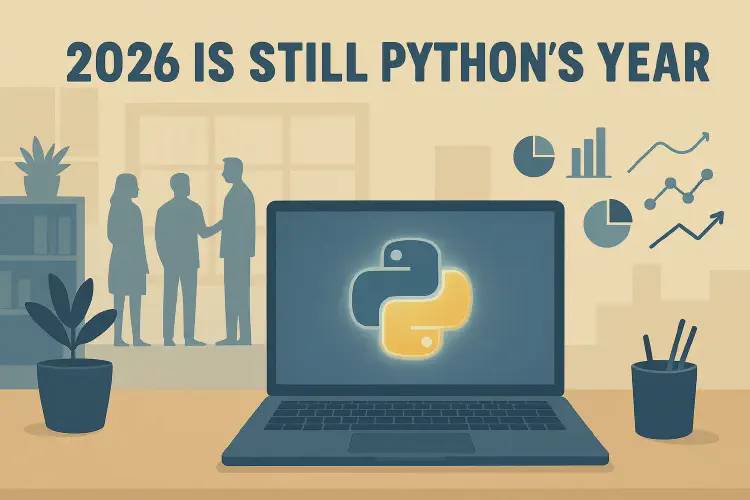
Python has spent more than a decade at the center of modern technology, powering tools, products, and entire industries, and its momentum shows no signs of slowing down. As we move into 2026, the language continues to dominate job postings, skill requirements, and learning roadmaps across the broader tech ecosystem. For beginners, this creates an unusual advantage: the most accessible programming language is also one of the most in demand.
Although new frameworks, trends, and tools appear every year, Python’s relevance has only solidified. If you are beginning your tech career in 2026, understanding why this stability exists will help you make smarter choices about what to learn, where to focus, and how to position yourself in a competitive market. Let’s explore why Python remains one of the strongest career bets in 2026.
A Job Market that Still Leans Heavily on Python
The job market landscape going into 2026 shows a consistent theme: Python remains one of the most requested programming languages across entry-level, mid-level, and specialized roles. Whether you look at analytics, back-end development, automation engineering, or machine-learning positions, Python appears in job descriptions more frequently than any other general-purpose language. A recent hiring analysis showed that Python appeared in over one million job postings worldwide in 2025.
This isn’t happening by accident. Companies continue to adopt Python for three main reasons: it reduces development time, it has a massive ecosystem of libraries, and it integrates seamlessly with data workflows. These advantages translate directly into hiring decisions. If managers want to ship products faster, analyze data more efficiently, or automate repetitive tasks, they need teams with Python skills.
For beginners, the implication is straightforward: choosing Python aligns your learning efforts with a large, established job market rather than a short-lived spike in popularity.
AI, Data, and Automation are Expanding, and Python Sits at the Center
One of the clearest reasons Python remains strong is its relationship with data, machine learning, and AI. As organizations race to integrate AI into operations, they increasingly rely on Python because the ecosystem around it is unmatched. Frameworks like pandas, NumPy, PyTorch, TensorFlow, FastAPI, and Streamlit give teams a simple way to prototype, build, and scale data-driven applications.
For beginners, this matters for two reasons. First, you don’t need deep math or AI expertise to start contributing. Python allows you to begin with fundamental programming concepts and gradually move into data handling or automation without changing languages. Second, the demand for data skills continues to rise across non-technical departments, marketing teams analyzing customer behavior, finance teams tracking performance metrics, and operations teams optimizing processes. Python, being both technical and accessible, fits these scenarios well.
In 2026, this dynamic becomes even more visible: companies don’t just want data specialists; they want employees who can interact with data fluently, automate small workflows, and support AI-driven initiatives. Python remains the most approachable path to building those capabilities.
Python’s Strength Lies in its Versatility
One of the reasons Python maintains such a strong presence is its ability to span multiple domains without compromising usability. A beginner might start by learning basic syntax, but from there the pathway branches into diverse career tracks:
- Data Analytics & Business Intelligence: Ideal for those interested in understanding business patterns and guiding strategy.
- Back-end Development – Using frameworks like Django or FastAPI to build scalable APIs and services.
- AI, Machine Learning & Automation: Where Python’s ecosystem becomes its biggest competitive advantage.
- Cybersecurity & Scripting: For teams needing quick, adaptable tools for automation and detection.
- Cloud & DevOps Support: Through automation scripts, infrastructure tooling, and orchestration frameworks.
This versatility is exactly why the language stays relevant. When a technology can evolve with industry needs it becomes a long-term career foundation rather than a trend.
Beginner-Friendly, but Not Limiting
Another often overlooked advantage is Python’s learning curve. Many beginners assume a programming language must be difficult to be “valuable,” but Python disproves that notion. Its readability and clear structure allow learners to focus on problem-solving instead of wrestling with syntax. This accelerates progress, builds confidence early, and shortens the timeframe between “learning concepts” and “building real projects.”
Importantly, this simplicity doesn’t limit career options later. Senior engineers, data scientists, and AI researchers rely on Python precisely because it helps them work faster. Beginners benefit from the same simplicity, but the opportunities scale upward as they grow.
Starting now place you ahead for 2026
The tech world evolves quickly, but Python’s position in 2026 reflects something unusual: stability in the middle of constant change. It’s approachable, versatile, and deeply embedded in modern workflows, from data analytics to AI. For beginners deciding where to start, this stability is not just comforting, it’s an advantage.
Choosing Python means choosing a language that grows with you, adapts to new career directions, and remains in demand across market cycles. As organizations continue expanding their data and AI capabilities, Python’s relevance only becomes stronger. And that makes 2026, once again, a very good year to begin your journey.
Start Your Python Journey with Linero Tech
If you’re ready to start learning Python, Linero Tech offers a structured, flexible course designed to help you succeed:
- Flexible Scheduling: Study at your convenience. Our course is designed to effectively teach you the fundamentals of Python in 12 weeks, but you get 16 weeks access.
- Expert Guidance: Direct access to an experienced developer and teacher, Humberto Linero.
- Practical Experience: Coding challenges to make sure that you learn and develop coding “muscle memory”.
👉 Discover our tech training programs
👉 See student reviews and success stories